Influencer Marketing Has 3 Layers
Most brands focus only on creators, content, and campaigns—the visible layer. But behind every strong influencer campaign is a strategy, system, and execution layer that actually drives results.
1 min read

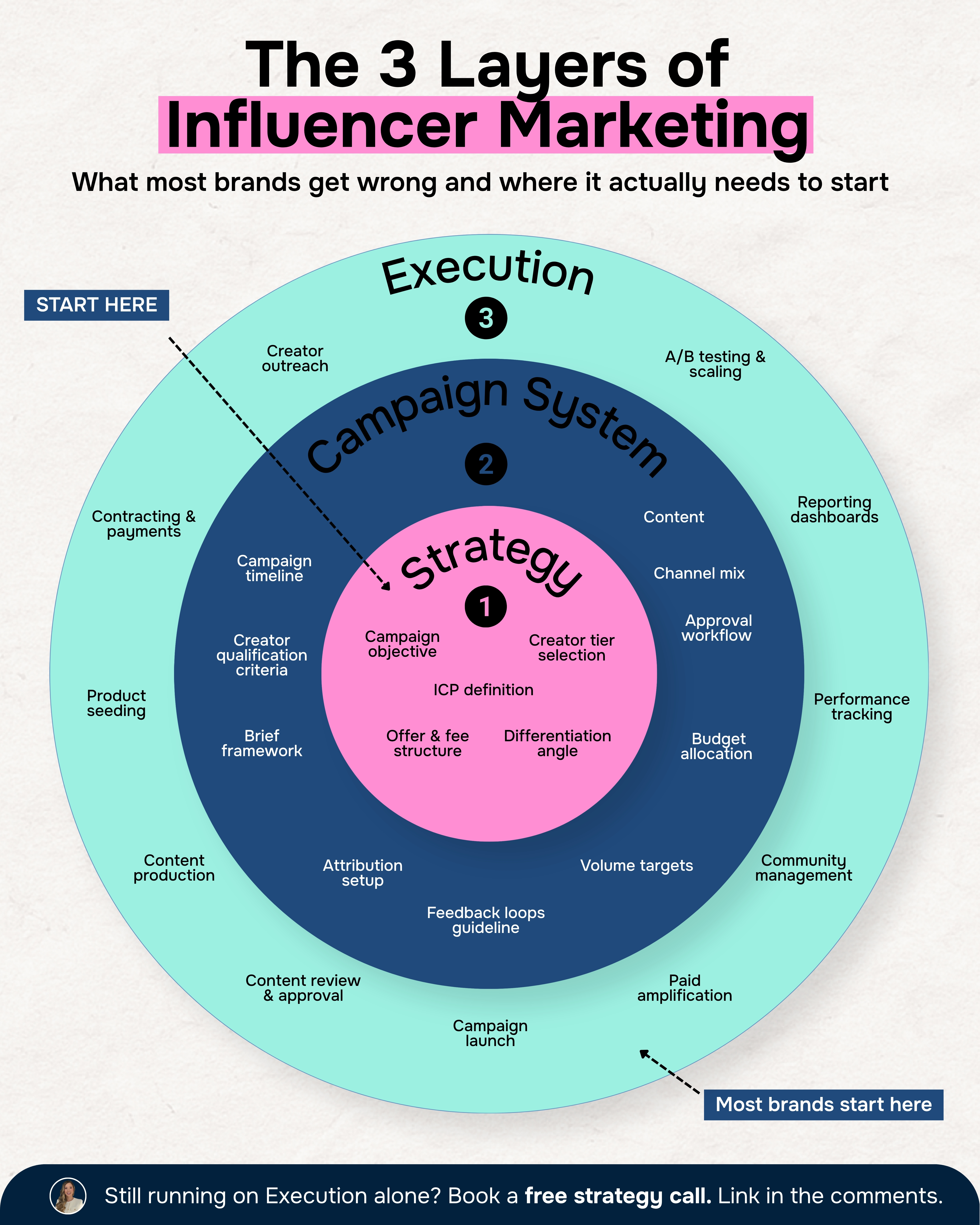
But most brands focus entirely on the third and skip the first two:
They think about creators, content, and campaigns.
But that's only the visible layer.
Behind every strong influencer campaign is a strategy, a system, and an execution layer.
Here's how we think about it for brands like Google, Audible, and Coca-Cola:
Layer 1: Strategy
Before you choose a creator, you need to know what the campaign is actually trying to achieve.
→ Define the business objective
→ Identify the audience you need to influence
→ Decide what role influencers should play
→ Define the success criteria
This is where creator selection starts.
Not with follower count.
Layer 2: Campaign System
Once the strategy is clear, you build the system that connects it to execution.
→ Define creator selection criteria
→ Build the briefing framework
→ Set measurement and attribution
→ Create feedback loops to learn from performance
This is what turns strategy into a repeatable system.
Without it, every campaign starts from zero.
Layer 3: Execution
Now you activate the system.
→ Find and activate creators
→ Produce and distribute content
→ Track performance
→ Test and optimize
→ Scale what works
This is the part everyone sees.
But it's not the part that makes the campaign strategic.
Here's why the sequence matters:
- Strategy tells you what to build.
- The system makes it repeatable.
- Execution brings it to life.
Skip the first two, and execution becomes guesswork.
Great creators can't fix a weak strategy.
More content can't fix a broken system.
Start with strategy. Build the system. Then execute.
Enjoy this?
Follow me on LinkedIn