Old-School Influencer Marketing Is Broken
Reach alone doesn't drive impact. Learn how to build smarter influencer marketing strategies by starting with business objectives and working backwards through seven key principles.
2 min read

More reach doesn't automatically mean more impact. Do this instead:
The best campaigns don't feel like media buying with a creator attached.
When I first started working in Influencer Marketing, you could get away without much of a strategy. You just picked a creator and started from there.
Who has the biggest audience? Who gets the most views? Who can we afford?
But everything changed once people stopped blindly trusting creators. That's why today, it's key to start with the business objective in mind and work backwards from there.
When you do that, every decision that follows becomes clearer. And there are a few things that make that possible:
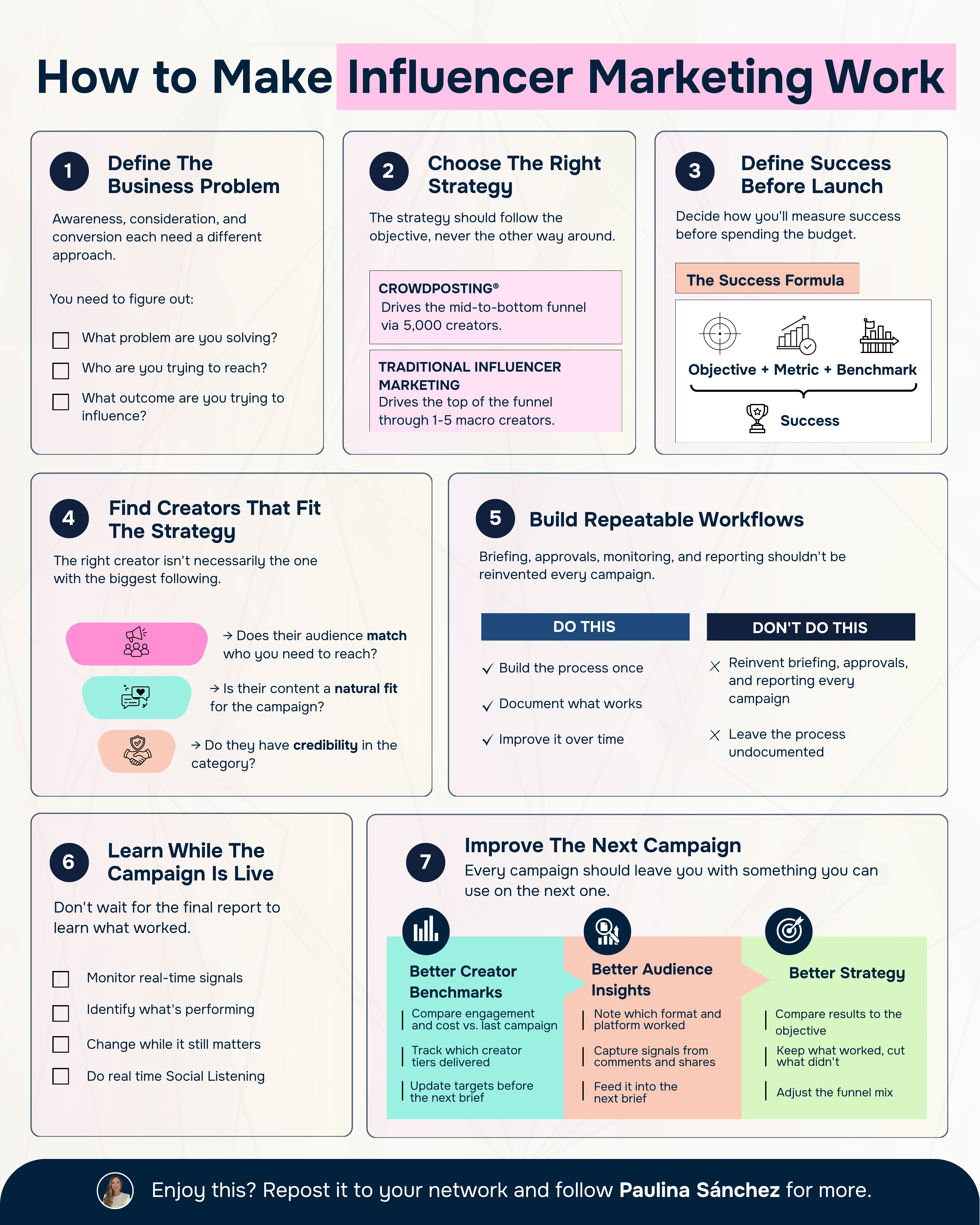
1. Define the Business Problem
Awareness, consideration, and conversion each require a different approach. Figure out:
→ What problem are we trying to solve?
→ Who are we trying to reach?
→ What business outcome are we trying to influence?
2. Choose the Right Influencer Strategy
Traditional Influencer Marketing, CrowdPosting®, or a combination of both.
CrowdPosting® drives the mid-to-bottom funnel via 5,000 creators; Traditional Influencer Marketing drives the top of the funnel through 1-5 macro creators.
→ The strategy should follow the objective, not the other way around.
3. Define Success Before Launch
Decide how you'll measure success before spending the budget.
→ What should we measure?
→ Which metrics actually connect to the objective?
4. Find Creators That Fit the Strategy
The right creator isn't necessarily the one with the biggest following.
→ Does their audience match who we need to reach?
→ Is their content a natural fit for the campaign?
→ Do they have credibility in the category?
5. Build Repeatable Workflows
Briefing, approvals, monitoring, and reporting shouldn't be reinvented every campaign.
→ Build the process once.
→ Document what works.
→ Improve it over time.
6. Learn While the Campaign Is Live
Don't wait for the final report to learn what worked.
→ Monitor real-time signals.
→ Identify what's performing best.
→ Make changes while they can still impact the results.
7. Improve the Next Campaign With What You Learned
Every campaign should leave you with something you can use to improve the next one.
→ Better creator benchmarks.
→ Better audience insights.
→ Better strategy.
Influencer Marketing gets better when you stop optimizing for reach and start building around the business outcome.
Enjoy this?
Follow me on LinkedIn