Overwhelmed by influencer marketing? Here's how to break it down.
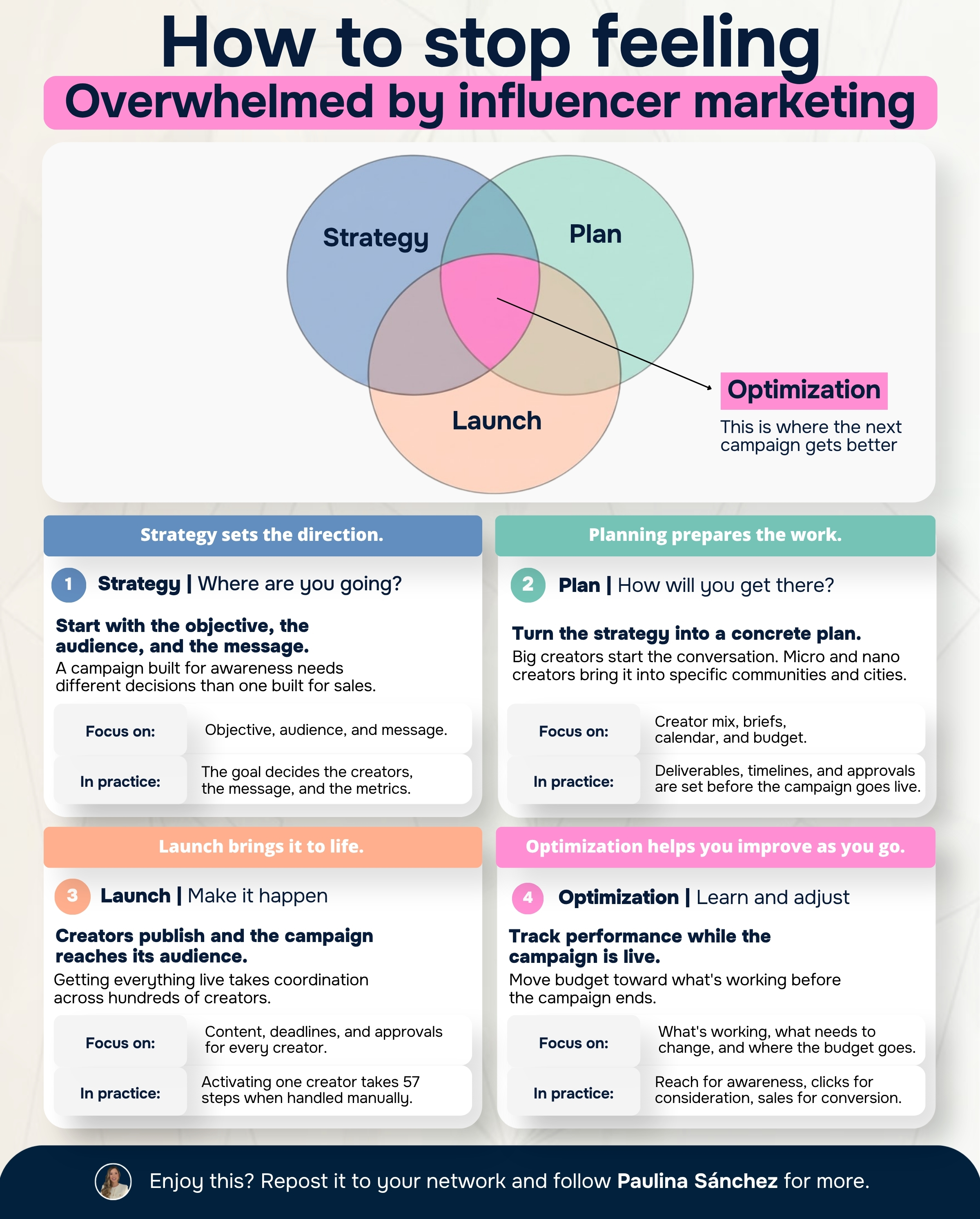
Every influencer campaign involves dozens of decisions. After 1,500+ campaigns, learn how to organize them into four connected parts: Strategy, Plan, Launch, and Optimization.
2 min read

Every influencer campaign involves dozens of decisions, from choosing creators and setting budgets to writing briefs, coordinating approvals, managing deadlines, and tracking results.
When you're managing hundreds of creators at once, all those moving parts can quickly become difficult to keep track of.
But they don't all need to be managed as separate tasks. They fit into four connected parts, each with a different purpose.
After 1,500+ campaigns, this is how I break them down:
1. Strategy: Where are you going?
Start with the objective, the audience, and the message.
A campaign designed to build awareness needs different decisions than one focused on generating sales. The goal determines which creators you need, what you want them to communicate, and how you'll measure success.
Without a clear objective, it's easy to spend time and budget on activity that doesn't move the business forward.
2. Plan: How will you get there?
Turn the strategy into a concrete plan: creator mix, briefs, calendar, and budget.
Big creators can help start a conversation, while micro and nano creators bring it into specific communities and cities. The mix depends on your audience, your objective, and the coverage you need.
This is also where you coordinate deliverables, timelines, and approvals before the campaign goes live.
3. Launch: Make it happen.
This is where creators publish, content goes live, and the campaign reaches its audience.
But getting everything live takes coordination.
Activating a single creator involves 57 steps when handled manually. Multiply that across hundreds of creators, each with their own content, deadlines, and approvals, and it's easy to see why execution needs a clear process.
The more organized the work is beforehand, the easier it is to keep everything moving.
4. Optimization: Learn and adjust.
Don't wait until the campaign ends to look at the results. Track performance while it's live and move budget toward what's working.
Reach helps measure awareness, clicks can indicate consideration, and sales show conversion. The metrics depend on the objective.
Use them to identify what's working, what needs to change and where to focus the remaining budget.
There's a lot to manage in an influencer campaign. These four steps help you keep everything organized. Strategy sets the direction. Planning prepares the work. Launch brings it to life. Optimization helps you improve as you go.
When each part has a clear purpose, it's easier to know what needs your attention and what comes next.
And every campaign becomes an opportunity to make the next one better.
Enjoy this?
Follow me on LinkedIn